Rooted in the Sacred: What Molokai's Taro Farmers Know About Healing That Modern Medicine Is Just Now Catching Up To
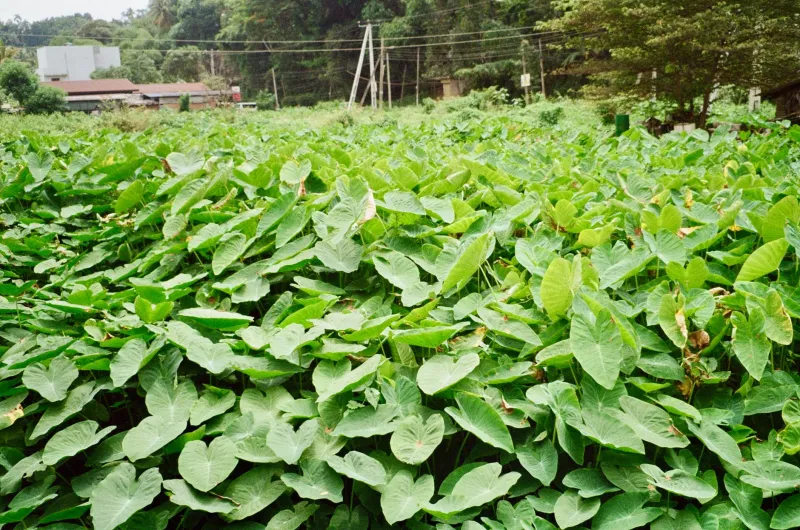
There's a patch of lo'i — a flooded taro field — on the western edge of Molokai's valley floor that has been tended continuously for generations. The water that feeds it moves down from the mountains through an 'auwai, a hand-dug irrigation channel that predates Western contact by centuries. The farmer who works it today rises before sunrise, not just because the work demands it, but because the protocols do. You don't enter the lo'i without intention. You don't harvest without gratitude. That's not folklore. That's practice.
And increasingly, that practice is catching the attention of nutritionists, integrative medicine doctors, and wellness researchers far beyond these islands.
Kalo Is Family — Literally
To understand why taro cultivation on Molokai feels different from anything you'll encounter at a farmer's market back home, you have to start with the Hawaiian creation story. In the Kumulipo, the cosmological chant that traces Hawaiian genealogy back to the origins of existence, kalo — the Hawaiian word for taro — is not just a plant. It's Hāloanakalaukapalili, the first-born child of the sky father Wākea and the earth mother Papahānaumoku. That child was stillborn, buried in the earth, and grew into the first kalo plant. The second child became the first Hawaiian person.
That means, in traditional Hawaiian cosmology, humans and taro are siblings. Not metaphorically. Literally.
This isn't a quaint origin myth that farmers recite for tourists. It's a living framework that shapes how people on Molokai relate to the land, to the plant, and to the act of growing food. When you eat poi — the fermented paste made from cooked and pounded kalo — you are, in the Hawaiian worldview, receiving nourishment from an elder sibling. That changes everything about how you grow it, how you harvest it, and how you eat it.
What the Science Actually Shows
Here's where things get genuinely fascinating for anyone who follows integrative nutrition or functional medicine trends. Kalo, particularly the varieties grown in traditional Hawaiian lo'i systems, is nutritionally extraordinary in ways that are now being documented by researchers at institutions like the University of Hawaii at Manoa.
Taro is one of the few staple starches that is highly digestible even for people with gut sensitivities. Its starch granules are significantly smaller than those found in potatoes or wheat, which means the digestive system processes it more efficiently with less inflammatory response. For people managing conditions like IBS, leaky gut, or autoimmune disorders — all of which have exploded in prevalence across the US — that's a meaningful difference.
Poi specifically, when allowed to ferment, becomes a prebiotic powerhouse. The fermentation process generates beneficial bacteria that support gut microbiome diversity. Some researchers have drawn comparisons to kefir or kimchi in terms of its probiotic profile, though poi's bacterial strains are distinct and, some argue, particularly well-suited to human digestion because humans have been eating it for over a thousand years.
Traditionally grown lo'i kalo also tends to be richer in calcium, phosphorus, and B vitamins than commercially grown taro. The flooded field system — which mimics wetland ecology — creates a specific soil chemistry that affects the plant's nutrient profile in ways that dry-land farming simply doesn't replicate.
Why Molokai Matters for All of This
Molokai has more active lo'i per capita than any other Hawaiian island. That's not an accident. It's the result of a sustained, community-driven effort to resist the kind of industrial agricultural conversion that transformed so much of Hawaii's other islands over the 20th century. Molokai's residents have, often at significant economic cost, protected their land from large-scale development and maintained small-scale, culturally grounded farming as a cornerstone of island life.
The farmers here aren't just growing food. They're maintaining a knowledge system. The specific varieties of kalo they cultivate — and there are dozens of named Hawaiian varieties, each with different flavors, textures, and medicinal applications — carry genetic information that has been selectively developed over centuries. Some varieties were traditionally used to treat specific ailments. Others were reserved for infants or elders. That ethnobotanical knowledge is inseparable from the spiritual protocols that govern the lo'i.
When you visit Molokai and encounter a working lo'i, what you're looking at is a living pharmacy, a cultural archive, and a spiritual practice all at once.
The Protocol Is the Medicine
One thing that gets lost when Western wellness culture extracts a food or practice from its indigenous context is the relational framework that makes it work. Turmeric pulled from Ayurvedic medicine and sold in a capsule at Whole Foods is useful, maybe. But it's a fragment of something much larger.
On Molokai, the healing properties of kalo are understood to be inseparable from the way it's grown. The prayers offered at planting. The care taken not to let stress or conflict enter the lo'i. The timing of harvest relative to lunar cycles. These aren't superstitions layered on top of agricultural practice — they're an integrated system in which the spiritual and the physical are not separate categories.
Some integrative health practitioners are beginning to articulate something similar in the language of modern science. Stress in farming environments — chemical inputs, soil disruption, industrialized harvesting — affects the epigenetic expression of plants in measurable ways. Conversely, low-stress, biodiverse growing environments produce plants with more complex phytochemical profiles. The Hawaiian concept of mālama 'āina — caring for the land — turns out to have biological consequences that show up in the food.
How to Engage Respectfully as a Visitor
If you're traveling to Molokai with an interest in kalo culture, there are meaningful ways to engage that go beyond passive tourism. Several community organizations on the island offer lo'i restoration workdays where visitors can participate in actual taro cultivation under the guidance of local farmers. This isn't a staged cultural experience — it's real work, and you'll be expected to show up with humility and follow the lead of the people who know this land.
Eating at local spots that serve traditional poi is another straightforward way to connect. Ask questions. Listen more than you talk. If someone shares knowledge with you, receive it as the gift it is rather than content to screenshot.
And if you leave Molokai thinking differently about what food is, what healing means, and what it looks like when a culture refuses to let its relationship with the earth be severed — that's the real medicine this island offers.
The lo'i has been doing its work for a very long time. It doesn't need your validation. But it might just change how you understand your own.