How to Give Without Keeping Score: Molokai's Quiet Lesson in Reciprocity
Somewhere between your third day on Molokai and your last, something tends to shift. It's not dramatic. You don't wake up with a revelation. It's more like a slow loosening — of the habit of calculating, of the reflex to ask "what do I owe you?" or "what do I get?"
Molokai does this to people. It has for a long time.
The island runs, in ways both visible and invisible, on a system of exchange that predates the dollar by centuries. Aloha isn't just a greeting here — it's an economic principle. Generosity isn't charity. It's infrastructure. And for visitors who arrive having spent their whole lives in a world where every transaction has a receipt, participating in this economy requires unlearning some deeply wired habits.
But it's worth it. Because what you gain on the other side of that discomfort might be the thing you didn't know you were missing.
What We Mean by Gift Economy
The term "gift economy" gets thrown around a lot in certain circles — usually at festivals or in progressive urban communities trying to build alternatives to capitalism. On Molokai, it's not a political project or a weekend experiment. It's a living practice rooted in kōkua (helping without expectation of return) and the understanding that resources, labor, and food are things communities share rather than individuals hoard.
This shows up in ways that visitors notice immediately if they're paying attention. A neighbor dropping off fish they caught that morning. A farmer sending someone home with more vegetables than they asked for. Community members showing up — unasked — to help with a project because the project benefits the whole. No invoice. No Venmo request. No ledger.
This isn't naivety about scarcity. Molokai knows scarcity intimately. It's a choice — a culturally embedded, actively maintained choice — to organize around abundance-sharing rather than individual accumulation.
The Visitor's Dilemma
Here's where it gets complicated for travelers: most of us have been trained to transact. We pay for things. We tip generously to signal respect. We buy local products because we know it helps the economy. These are good impulses, and on Molokai, spending money at locally owned businesses absolutely matters.
But the gift economy operates in a different register — one where pulling out your wallet can actually be the wrong move. When a local family invites you to share a meal, offering to pay for it doesn't honor the gift. It converts it into a service transaction and, in doing so, misses the entire point.
This is the visitor's dilemma on Molokai: how do you participate in a reciprocal economy when you're only here for a week and you don't have a fishing boat or a taro patch to contribute?
Practical Ways to Participate Ethically
Show up with your hands, not just your wallet. Several community organizations on Molokai welcome visitors who want to contribute labor — fishpond restoration, beach cleanup, taro farming, community garden maintenance. This isn't voluntourism in the extractive sense (where the volunteer gains more than they give). It's showing up as a body that can carry things, pull weeds, and take direction. Ask before you assume, and follow the lead of community members about what's actually needed.
Receive gracefully. This sounds passive, but it's genuinely hard for Americans raised on self-sufficiency. When someone on Molokai gives you something — food, a story, directions that turn into a two-hour conversation — the gift is in receiving it fully. Not deflecting. Not immediately trying to reciprocate with money or a gift of equal "value." Just saying thank you and meaning it.
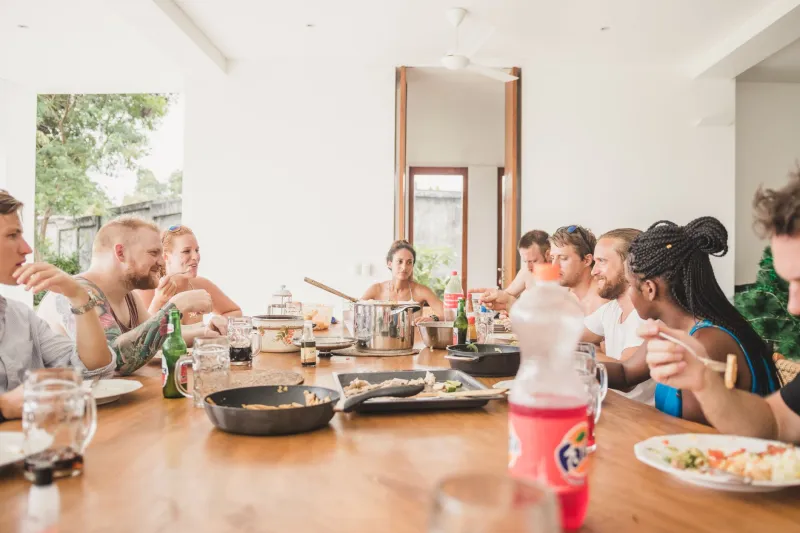
Bring something to share, not something to sell. If you're staying somewhere with a kitchen, cook. Share food with neighbors if the opportunity arises. Bring something from your own community that has meaning — not as a trade, but as an introduction of yourself. This is how relationships begin in reciprocal cultures: through the exchange of something that carries a piece of who you are.
Let go of the accounting. The hardest part. The gift economy doesn't balance in real time. You might receive far more than you give during a single visit. That's okay — because the assumption is that the balance exists across a longer arc, a wider community, a more expansive sense of what "exchange" means. Trust the system instead of trying to square it.
What You Lose — and What You Find
Participating in Molokai's gift economy costs something real. It costs the comfort of knowing exactly where you stand. It costs the control of the transactional model, where you pay and therefore you're done, obligation discharged. It costs the efficiency of just buying your way through an experience.
What you gain is harder to name but easier to feel. A sense of being woven into something rather than passing through it. The particular warmth of having been genuinely helped — not because you could afford it, but because someone chose to. The discovery that you have things to offer that have nothing to do with your credit card limit.
Several visitors to Molokai describe this shift as one of the most disorienting and ultimately transformative parts of their time on the island. Not the hikes, not the scenery — the moment they stopped calculating and started just being present in an exchange.
"I kept waiting for the catch," admits one traveler from Atlanta who spent two weeks on the island. "And then I realized — there isn't one. That's the whole point. And I didn't know how to handle that at first. By the end, I didn't want to go back to handling it any other way."
Molokai won't hand you a pamphlet on any of this. The lesson is in the living of it — in the fish left on your doorstep, the story shared over coffee, the hand extended without a price attached. Pay attention. The island is teaching, whether you've signed up for class or not.