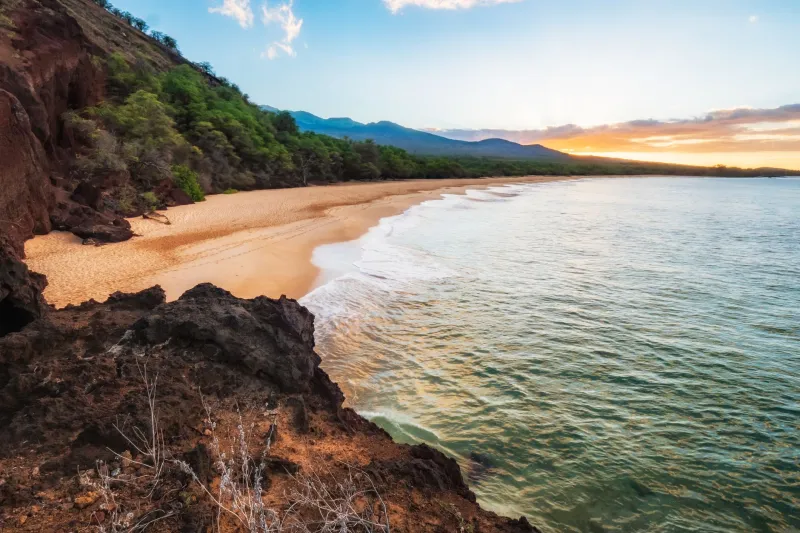
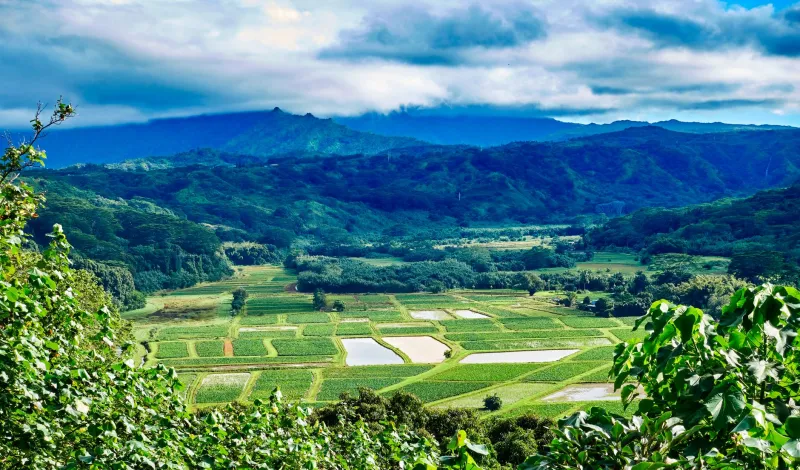
Your Nervous System Has Been Waiting for This Island: The Science Behind Molokai's Quiet Reset
Photo: Daniel Romanson, CC0, via Wikimedia Commons
Let's start with something almost everyone who spends time on Molokai reports: they sleep differently here. Not just better — differently. Deeper, stranger, more vivid. They wake up without an alarm and feel actually rested, sometimes for the first time in years. Their dreams get louder. Their mornings get quieter.
This isn't coincidence, and it isn't entirely mystical either. It's biology — specifically, it's what happens when a human nervous system that has been running in a low-grade state of chronic overstimulation finally gets what it's been starving for.
Molokai, almost accidentally, provides nearly all of it.
The Overstimulation Baseline
Before we talk about what Molokai does, it helps to understand what mainland American life does to a nervous system over time.
The average American is exposed to somewhere between 4,000 and 10,000 advertising messages per day. Urban light pollution means most people never experience true darkness. Traffic noise, HVAC systems, and ambient digital sound keep the auditory cortex in a constant low-level processing state. Social media platforms are engineered — literally, by teams of behavioral scientists — to trigger dopamine spikes that keep users engaged and slightly anxious.
None of this is breaking news. But the cumulative neurological effect is significant. Chronic low-grade stress keeps the sympathetic nervous system — the "fight or flight" branch — in a state of mild but persistent activation. Over time, this becomes the baseline. People stop noticing it because it's all they've ever known.
Then they go to Molokai.
What the Darkness Does
Molokai has some of the least light pollution of any inhabited place in the United States. On a clear night, the Milky Way is not a faint smear — it's a structural presence in the sky, detailed and overwhelming in the best possible way.
This matters physiologically because human melatonin production is exquisitely sensitive to light. Artificial light after dark — especially the blue-spectrum light from screens — suppresses melatonin, delays sleep onset, and disrupts the circadian architecture that governs everything from immune function to emotional regulation.
Without that interference, the body's natural light-dark cycle reasserts itself quickly. Most visitors report that within two or three nights on Molokai, they're falling asleep earlier and waking with the dawn — not because they're trying to, but because their bodies are finally operating on the schedule they evolved for.
Dr. Sasha Mori, a sleep researcher who studies the effects of natural light environments on human health, puts it plainly: "We've essentially been running biological software designed for starlight on hardware flooded with fluorescent input. Remove the fluorescence, and the software runs correctly. It's not magic. It's just what the system was built to do."
The Sound of Nothing (Which Is Actually Something)
Molokai is quiet in a way that most Americans have never experienced. Not silent — the ocean is always present, birds are everywhere, wind moves through ironwood trees in a frequency that's almost musical. But the commercial noise floor that underlies most American environments — the traffic, the machinery, the constant low hum of industrial civilization — is largely absent.
This distinction matters. Research in acoustic ecology and environmental psychology has consistently found that natural soundscapes have measurably different effects on the nervous system than urban noise environments, even when both register at similar decibel levels. Natural sounds — ocean waves, birdsong, wind — tend to activate the parasympathetic nervous system, the "rest and digest" branch that counterbalances the stress response. Urban noise, by contrast, tends to do the opposite.
The ocean in particular has drawn significant scientific interest. Low-frequency infrasound from wave action — below the threshold of conscious hearing — appears to influence brainwave states, potentially nudging the brain toward the slower alpha and theta frequencies associated with relaxed alertness and meditative states. Hawaiian coastal communities have understood this relationship between ocean sound and human wellbeing for generations. The science is only now catching up.
"I tell my clients who are dealing with anxiety or burnout that the single most effective intervention I've found isn't a supplement or a protocol," says Leilani Kahale, a holistic wellness practitioner based on Maui who has worked with Molokai visitors. "It's extended time in a natural acoustic environment. The nervous system just starts to let go."
Social Rhythm as Medicine
Here's something that doesn't show up in the neuroscience literature as often as it should: the pace of social life on Molokai is itself a kind of medicine.
In most American social contexts, there is an implicit expectation of responsiveness, productivity, and efficient interaction. Conversations have agendas. Silences feel awkward. Time is money, and spending it slowly in the presence of another person carries a faint social cost.
On Molokai, the social rhythm is different. Conversations unfold without urgency. People sit together without needing to justify the sitting. There's a cultural comfort with stillness that visitors often describe as initially disorienting and eventually, profoundly relaxing.
From a neuroscience perspective, this matters because social cues are among the most powerful regulators of nervous system state. We are deeply wired to read the arousal levels of the people around us and unconsciously mirror them — a phenomenon researchers call co-regulation. When the people around you are genuinely unhurried, your nervous system picks up that signal and responds accordingly.
This is one reason why Molokai's effects can't be fully replicated by going to a quiet place alone. It's not just the environment — it's the people in it.
Harnessing the Reset Intentionally
Knowing the mechanisms behind Molokai's effects doesn't diminish them — if anything, it helps visitors engage more deliberately with what the island is offering.
A few practices that long-term visitors and wellness practitioners recommend:
Put the phone away early. Not just on silent — away. The light and the social pull of notifications undercut the natural rhythm reset faster than almost anything else. Give yourself at least the hours between sunset and sleep.
Spend time near the water every day. Not necessarily swimming — just being proximate to the ocean, listening to it, letting its rhythms register in your body.
Resist the urge to fill silence. In conversations, in your own head, in the space between activities. The discomfort of unstructured time is part of the recalibration process. Sit with it.
Stay long enough. Most visitors report that the deepest shifts happen after the first week. If you can manage two weeks or more, the changes have time to become structural rather than just situational.
Molokai's residents have built a way of life that, among many other things, happens to be extraordinarily good for the human nervous system. That's not an accident — it reflects a sophisticated understanding of what people need that long predates the science we're now using to describe it.
Your body already knows this place, in some deep evolutionary sense. Molokai just reminds it.