The Valleys That Refused to Forget: Reading Molokai's Hidden Landscapes as Living History
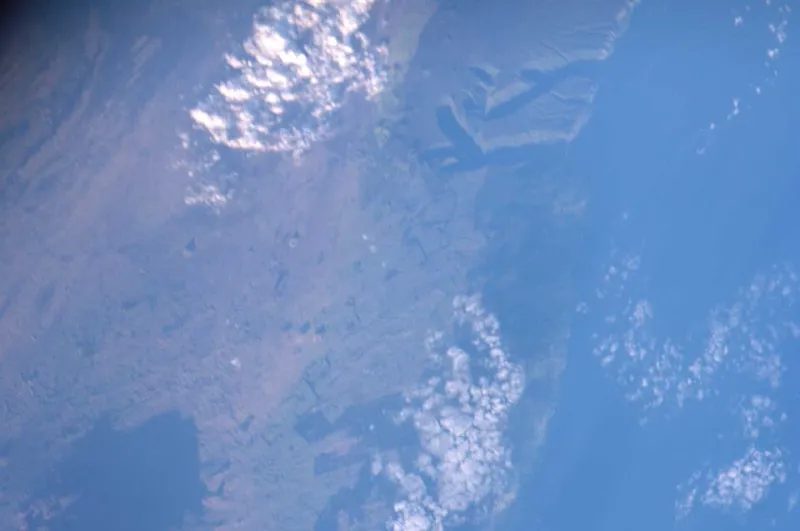
Photo: Earth Science and Remote Sensing Unit, Lyndon B. Johnson Space Center, Public domain, via Wikimedia Commons
Get to the end of the road on Molokai's north shore — and there is, literally, an end of the road — and you'll find yourself standing above one of the most dramatic coastlines in the Pacific. The sea cliffs here are among the tallest in the world. Below them, accessible only by mule trail or water, lie valleys so remote and so green they seem to exist outside of time.
Halawa. Wailau. Pelekunu. Papalaua.
These are not just geographic features. They are archives. Each one holds layers of Hawaiian history — habitation, cultivation, displacement, and in some cases, ongoing return — that no museum exhibit could adequately convey. To stand in one of these valleys is to stand inside a story that is still being written.
For the conscious traveler willing to do the work — physical, intellectual, and ethical — of reaching them, they offer something increasingly rare: contact with a landscape that has not been curated for your comfort.
What the Land Holds
Halawa Valley, at the island's eastern tip, is the most accessible of Molokai's ancient inhabited valleys and the one with the longest continuous human history — estimates suggest habitation going back at least 1,500 years, making it one of the earliest settled places in all of Hawaii.
The valley's lo'i kalo — flooded taro paddies — were once among the most productive in the archipelago. They fed communities, sustained ceremonies, and embodied the Hawaiian understanding of taro (kalo) as a direct ancestor of the human race. When Western contact, introduced disease, and eventual land dispossession devastated Hawaiian communities across the islands, Halawa's population collapsed from thousands to a handful.
But here's what the postcard version of Hawaiian history tends to skip: the land didn't give up. And neither did the people connected to it.
Over the past two decades, families with deep ties to Halawa have been engaged in active restoration of the valley's taro cultivation — not as a heritage performance, but as a living practice. The lo'i are wet again. The knowledge of how to maintain them is being passed between generations in real time. This is not nostalgia. It's continuity.
"People ask me if we're trying to bring back the past," says one community member involved in Halawa's restoration work, who asked to be identified only by her Hawaiian name. "I tell them no. The past never left. We're just making it visible again."
The Valleys You Can't Drive To
Wailau and Pelekunu, tucked into the folds of the north shore's impossible cliffs, are accessible only by boat in calm weather or by a grueling trail that most people don't attempt. This inaccessibility is not incidental — it's historical.
During the 19th and early 20th centuries, these remote valleys became refuges for Hawaiian families who had survived the worst of colonial disruption and were trying, in the only way left available to them, to maintain something of their way of life away from the reach of plantation economy and missionary pressure. The valleys' difficulty was their protection.
Walking into Wailau today — if you have the skill, the permission, and the physical conditioning to do it — means walking through the remains of a community that chose remoteness over assimilation. Stone platforms that once supported homes are visible beneath the vegetation. Irrigation channels carved into hillsides speak to the agricultural sophistication of people who built productive lives in one of the most challenging environments in Hawaii.
These aren't ruins in the conventional sense. They're evidence. Evidence that Hawaiian people were not passive recipients of historical forces but active agents who made strategic choices about how to survive and what to protect.
Land Stewardship as Resistance
The Nature Conservancy's Molokai preserve protects a significant portion of the island's native forest and watershed, including much of the land above the north shore valleys. But the more interesting stewardship story — and the one that gets less outside attention — is what's happening at the community level.
Across Molokai, residents are engaged in a range of land-based efforts that blur the line between conservation and cultural practice. Invasive species removal in native forest corridors. Restoration of coastal fishponds whose engineering principles go back centuries. Replanting of native plants that have specific ceremonial and medicinal significance. Maintenance of trails and access routes to places that, if neglected, would become unreachable.
These efforts are explicitly understood by their participants not just as environmental work but as acts of cultural continuity — a way of keeping the relationship between people and land alive in a form that can be passed on.
"The land holds memory," says Kimo Akana, who has been involved in native forest restoration on Molokai for more than a decade. "When we work it, when we tend it, we're in conversation with everyone who tended it before us. That's not metaphor. That's how it actually works."
How to Engage as a Visitor
Let's be direct about something: most of Molokai's remote valleys are not open for independent tourist exploration. Some are private land. Others require guides with specific knowledge and community relationships. A few are genuinely dangerous without local expertise.
This is not a barrier to engagement — it's an invitation to engage correctly.
Halawa Valley offers guided cultural hikes led by residents with deep family connections to the land. These aren't generic nature tours. They're opportunities to hear the valley's history from people who carry it in their bodies, to ask questions that matter, and to contribute — through your participation fee — directly to the community members doing the ongoing work of cultural maintenance.
Beyond Halawa, the path to the less accessible valleys runs through relationship. Visitors who spend extended time on Molokai, who show up at community events, who make themselves known and trusted, sometimes find doors opening that aren't listed on any website.
This is how it should work. The valleys aren't attractions. They're relationships waiting to be earned.
A Different Kind of Map
Most travel guides to Hawaii organize landscape by visual spectacle — the most dramatic overlook, the clearest snorkeling water, the most photogenic waterfall. Molokai invites a different organizing principle.
What if you mapped an island not by what it looked like, but by what it remembered? What if the question you brought to each valley, each shoreline, each trail wasn't "Is this beautiful?" but "What happened here, and who is still tending it?"
That's the kind of travel that Molokai rewards. Not the passive consumption of scenery, but the active practice of attention — to land, to history, to the people who have never stopped caring for both.
The valleys that refused to forget are still here. The question is whether you're willing to show up in a way that's worthy of what they're holding.