Where the Land Remembers: Mapping Molokai's Living Grid of Sacred Power
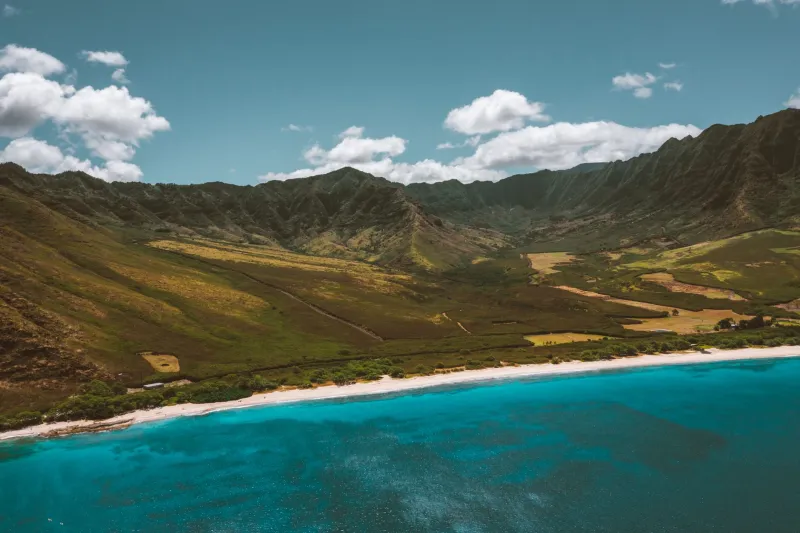
Some places make you feel something before you can explain it. You round a bend on a red-dirt road, step into the shadow of a sea cliff, or stand at the edge of a valley so green it almost hurts — and something in your chest shifts. You're not imagining it. On Molokai, that feeling has a name, a history, and a geometry.
The Hawaiian concept of mana — spiritual power, life force, the animating energy that moves through people, places, and living things — isn't metaphorical. To the indigenous Hawaiian worldview, mana is as real and measurable as water flow. And Molokai, long called Molokai Pule O'o (Molokai of the Powerful Prayer), has long been understood as one of the most mana-saturated places in the entire island chain. The kahunas (spiritual practitioners) who trained here weren't just drawn by reputation. They were drawn by geography.
The Island as a Living Map
When you look at Molokai from above — or even trace its outline on a map — something becomes apparent. The island is elongated, stretching east to west, with its most spiritually significant sites distributed across its length in a pattern that feels less like coincidence and more like intention. From the towering sea cliffs of the north shore to the low-lying fishponds of the south, from the upland forests of the east to the arid western plains, the landscape shifts dramatically. And within those shifts, certain sites carry an unmistakable weight.
Traditional Hawaiian cosmology doesn't use the word "ley lines" — that's a Western import — but the underlying concept of energy pathways moving through the land is deeply embedded in Hawaiian thought. The idea that certain locations are wahi pana (storied, sacred places) and that these places are connected through shared spiritual significance is not new. What's newer is the language conscious travelers bring to it, and the question of how to engage with it respectfully.
Kuahelani and the Spiritual Reputation of the Island
Long before the first tourist set foot on Molokai, the island was known across Hawaii as a place of immense spiritual authority. Ancient chants reference Molokai as Kuahelani, a mythic homeland associated with the gods. The island's kahuna tradition was so powerful that practitioners from other islands would come here specifically to study. This wasn't just cultural prestige — it was an acknowledgment that the land itself was a kind of teacher.
That tradition didn't disappear. It went quieter, yes. But the places it consecrated remain.
Phallic Rock and the Mana of Fertility
Perched in the upland forest of Pala'au State Park, Kauleonanahoa — commonly known as Phallic Rock — is one of the most visited sacred sites on the island, and also one of the most misunderstood. Tourists sometimes treat it as a novelty. But for Hawaiian women who have traditionally made the journey to the site seeking fertility, it is a place of genuine spiritual petition.
The rock's power isn't separate from the landscape around it. The dense, cool forest of Pala'au — one of the few places on Molokai where you feel genuinely enclosed by nature — creates a contained energetic environment. The site sits at an elevation that feels removed from the island's more exposed coastline, as though it occupies a different atmospheric layer. Whether you frame that as spiritual energy or simply as the accumulated weight of centuries of human intention and prayer, the effect is real. You feel it when you arrive.
Conscious travelers who visit Phallic Rock are encouraged to approach it the way they would any sacred site: quietly, without extracting anything (including photos taken in a mocking spirit), and with some awareness of what the site has meant to the people for whom it was never a curiosity.
The North Shore Cliffs: Mana at Scale
Molokai's north shore is home to the tallest sea cliffs in the world — a fact that impresses the ego but barely scratches the surface of what those cliffs actually represent. The valleys carved into the cliff face, including Wailau, Pelekunu, and Halawa, are among the most isolated places in the United States. Most are accessible only by sea or by difficult trail. And within them, the remnants of ancient Hawaiian settlements — taro terraces, heiau (temple platforms), stone walls — sit largely undisturbed.
These valleys aren't museum pieces. They are places where the land has continued its own life, largely free from the disruptions that transformed the rest of Hawaii. The mana associated with them is the mana of continuity — of a relationship between people and place that was never fully severed. Standing at the cliff's edge above them, or arriving by boat into the quiet of Pelekunu Bay, many visitors report a feeling of entering a different kind of time. That's not tourism language. That's the honest description of what happens when you encounter land that has not been told what it is by a development brochure.
Halawa Valley: Where the Energy Lines Converge
If Molokai has a spiritual epicenter, many who know the island well point to Halawa Valley on the eastern tip. The valley is one of the oldest continuously inhabited places in Hawaii, with settlement dating back at least 1,400 years. It holds two heiau, a waterfall, ancient lo'i (taro paddies), and a community of families who have never left.
Guided cultural tours of Halawa — led by descendants of the valley's original families — are not optional extras for the curious. They are the only appropriate way to enter. And within those tours, something remarkable happens: the guides don't just tell you about the valley's history. They tell you how to be in it. Where to step. What to acknowledge. How to receive what the land is offering without taking more than your share.
This is the living geometry of aloha — not a bumper sticker sentiment, but a navigational system. A way of moving through sacred space that keeps the relationship between visitor and place from collapsing into extraction.
How to Travel These Lines Without Erasing Them
The question conscious travelers always face on Molokai is: how do I engage with something sacred without diminishing it? Here are a few principles that the island itself seems to teach:
Go slowly. The energetic quality of Molokai's sacred sites is not available at speed. Slow down to the pace of the place, not the pace of your itinerary.
Ask before entering. Many of Molokai's most significant sites are on private or community land. The protocol of asking permission — komo mai culture — is not bureaucratic. It's relational. It's the beginning of a real exchange.
Receive, don't collect. Leave things where you find them. This includes rocks, plants, and photographs taken in a spirit of ownership rather than gratitude.
Let silence do its work. The mana of Molokai is not loud. It doesn't perform for visitors. Sit with it long enough, quietly enough, and it becomes available to you in ways that no amount of reading can replicate.
The Grid Is Still Active
Modern travelers are increasingly drawn to places that feel real in an era of relentless simulation. Molokai offers something genuinely rare: a landscape whose spiritual architecture is intact. The heiau still stand. The valleys still hold their silence. The families who carry the knowledge of these places are still here, still tending the relationship between the living and the land.
You don't have to be Hawaiian to feel what moves through this island. You do have to be willing to approach it on its own terms — to let the geometry of aloha reshape your expectations before you arrive, rather than after you've already taken something that wasn't yours to take.
The lines are still active. The question is whether you're ready to walk them with the care they deserve.