Staying Long Enough to Listen: How Molokai Is Becoming America's Most Unlikely Spiritual Apprenticeship

Photo by Photo by Justin Busa on Unsplash on Unsplash
There's a moment that nearly every long-term visitor to Molokai describes, and it usually happens somewhere around day four or five. The restlessness fades. The compulsive phone-checking stops feeling automatic. And something underneath all that noise — something they hadn't realized was missing — starts to surface.
For Renata Osei, a social worker from Atlanta who first came to Molokai three years ago after burning out completely, that moment arrived while she was sitting on the red dirt shoulder of a road watching a man repair a fishing net. Nobody was rushing. Nobody was performing productivity. "I started crying and I didn't even know why," she says. "I think I was just relieved."
She has returned twice since. Her stays have grown longer each time.
A Different Kind of Destination
Molokai doesn't market itself the way Hawaii's other islands do. There are no major resort chains, no luau dinner shows choreographed for tourists, no airport packed with lei vendors. The island's residents — many of them Native Hawaiian — have made deliberate, collective choices to keep things that way. And increasingly, that deliberateness is exactly what's drawing a particular kind of traveler.
Calls them pilgrims, apprentices, seekers — the language varies, but the impulse is consistent. These are people who have decided that a standard vacation, with its carefully buffered distance from real life, isn't what they need. They want friction. They want depth. They want to be somewhere that asks something of them.
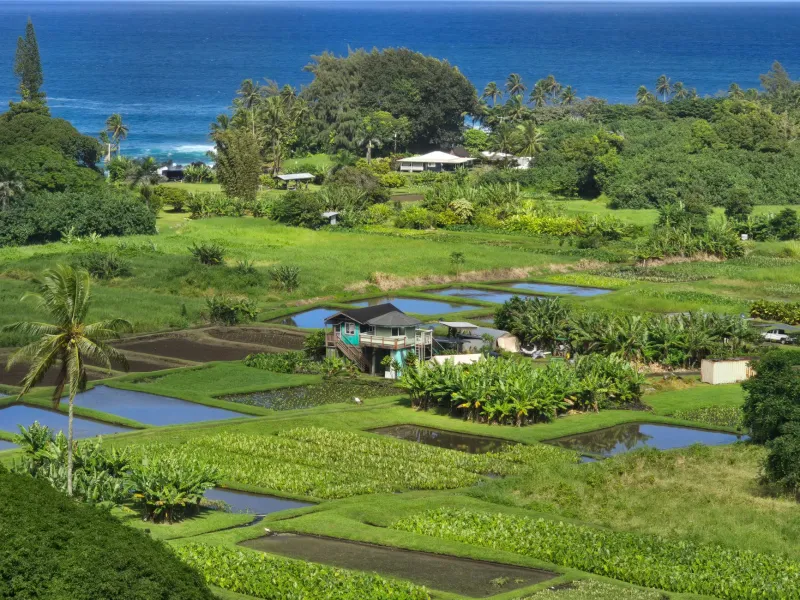
Molokai, with its deep roots in Hawaiian spiritual practice, its working taro farms, its elders who still carry ancient knowledge in living form, and its fierce community ethic, has a way of delivering exactly that — on its own terms.
"This island has a gravitational pull," says Marcus Lind, a former tech executive from the Bay Area who spent six weeks on Molokai after leaving his job. "But it's not the kind that flatters you. It's the kind that strips things off."
What Makes This Different from Wellness Tourism
It's worth being honest about what Molokai is not. It is not a wellness retreat center with a structured curriculum, a spa menu, and a certificate of completion. There is no program director, no morning intention-setting circle unless you organize one yourself, and no curated "transformation package" for $4,000 a week.
That's precisely what distinguishes it from the booming wellness tourism industry — a sector that, for all its genuine appeal, can sometimes package spiritual growth into something that feels suspiciously like a luxury purchase.
What Molokai offers instead is proximity to a living culture that has never stopped practicing what many mainland Americans are only now beginning to seek. The concept of mālama ʻāina — caring for the land as a sacred responsibility — isn't a workshop theme here. It's how people actually organize their days. The intergenerational transmission of knowledge, the communal relationship to food and ocean, the understanding that healing is inseparable from place: these aren't imported philosophies. They're the texture of daily life.
For visitors willing to show up with humility, that proximity is genuinely transformative. But it requires something in return.
The Ethics of Showing Up
This is where the conversation gets complicated, and where responsible travelers need to sit with some discomfort.
Molokai's community has been explicit, repeatedly and publicly, about what they don't want from tourism. They don't want their culture extracted and commodified. They don't want their sacred sites treated as photo opportunities. They don't want visitors who arrive with the assumption that Hawaiian spirituality is a resource available for personal consumption.
So how do you visit in a way that's genuinely reciprocal?
Long-term visitors who've navigated this successfully tend to describe a similar approach: arrive slowly, spend money locally and intentionally, ask before you photograph, volunteer before you explore, and follow the lead of community members rather than guidebooks. Several mentioned that their most meaningful experiences came not from seeking out spiritual encounters, but from simply making themselves useful — helping on a farm, showing up to a community cleanup, learning to cook something traditional from someone willing to teach.
"The island will open to you when you stop trying to open it," says Keani Makoa, a cultural practitioner from Molokai who works with visitors through a small community-run cultural education initiative. "Come to give, not to get. That's the oldest teaching there is."
There are also practical considerations. Extended stays mean renting from local families rather than booking the one or two vacation platforms that pull money off-island. It means eating at locally owned restaurants, buying from the farmers market, and understanding that your presence has an economic footprint that either supports or undermines the community you came to learn from.
The People Who Keep Coming Back
What's striking about the repeat visitors is how consistent their accounts are, even when they come from completely different backgrounds.
A retired nurse from Minnesota who has spent parts of three consecutive winters on Molokai describes it as "the only place I've ever been where I feel like the land is paying attention to me." A documentary filmmaker from Brooklyn talks about returning to finish a project that the island, she feels, "wasn't done with yet." A father of three from Denver brought his teenage son for a two-week stay after the boy's anxiety had become unmanageable, and describes watching something in his kid quietly reset.
None of them are claiming miracles. Most are careful, even a little sheepish, about the language they use. But they share a conviction that whatever happened to them on Molokai wasn't incidental — that the island's particular combination of cultural depth, environmental stillness, and communal integrity created conditions for change that they couldn't replicate anywhere else.
"I've done the retreats," says Renata Osei. "I've done the meditation apps and the therapy and the sabbaticals. Molokai is the only thing that actually changed the baseline. And I'm still not entirely sure how."
How to Begin
If you're considering an extended stay, start by doing your homework — not on travel review sites, but on the island's history, its ongoing land sovereignty issues, and the voices of its residents. Read work by Native Hawaiian scholars and writers. Understand what you're walking into before you walk in.
Connect with community-based organizations before you arrive. Look for opportunities to contribute, not just consume. Plan to stay at least two weeks if you can — most visitors say the first week is just decompression, and the real experience begins in the silence that follows.
And when you get there, resist the urge to fill every hour. The apprenticeship, if that's what you want to call it, begins the moment you stop managing your own experience and start letting the island set the pace.
That's not a small thing to ask of an American traveler in 2025. But Molokai has never been in the business of making things easy. It's in the business of making things real.